How do we know what's inside us?
Look at your hand. It's made of cells, billions of them, all doing their jobs right at this moment. And yet you can't see a single one of them, and until very recently, nobody could.
The cells in your body have been there your entire life, doing every single thing you do, making energy, delivering oxygen, folding proteins, firing electrical signals. But until about 350 years ago, no human being on Earth had ever actually seen one. And until much more recently than that, nobody had seen the parts inside of a cell.
How did we ever find this out?
You are made of cells
Roughly 37 trillion. Some carry oxygen, some send electrical signals from your spine to your toes, some contract every time you bend a finger, some stack into a tough waterproof barrier we call skin, and some build the bones that hold you up.
And every one of them knows exactly what to do. We cut ourselves and skin cells start dividing to close the wound, we skip a meal and liver cells release stored sugar to keep the brain working, we catch a cold and immune cells start producing antibodies against the virus before we even feel sick. Nothing is directing this centrally, every cell carries its own instructions. All of this, every minute of every day, in every person who has ever lived. And for almost all of that time, nobody knew any of it was happening.
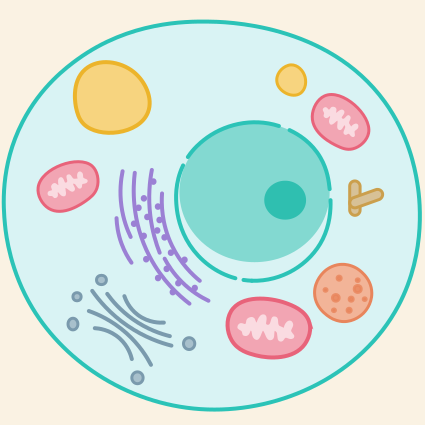
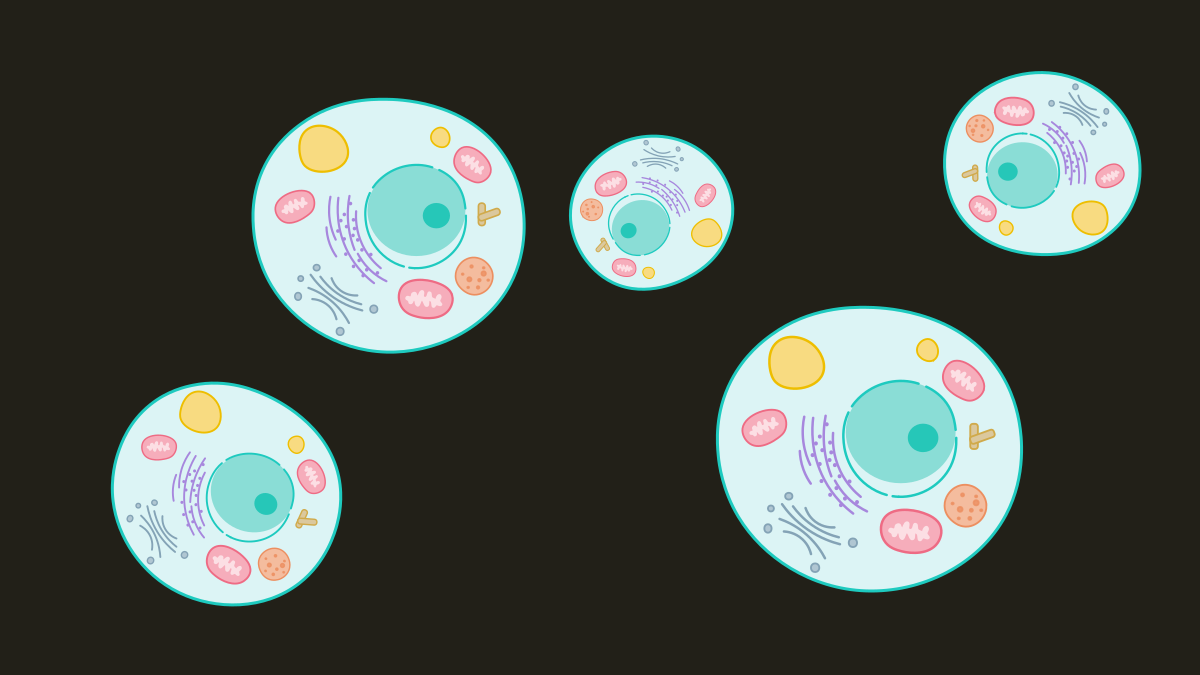
Cells don't all look the same, but they're all built the same way underneath. Zoom into any one of them and you find a similar set of parts doing similar jobs - a nucleus holding the DNA, mitochondria making energy, an endoplasmic reticulum folding new proteins, and a Golgi apparatus packing them up and shipping them out.
The problem is, you can't see them.
The size problem
Imagine an apple in your kitchen. A grain of rice is about twenty times smaller than the apple. A typical human cell is about a hundred times smaller than that grain of rice. The structures inside the cell are even smaller, some of them a thousand times smaller again.
This is why we went tens of thousands of years without knowing any of this existed. The naked eye doesn't go that small, not even close.
The first tool
In cell biology, almost everything we know came from somebody finding a way to see what we couldn't, because biology moves when its tools move. An entire world was just past what our eyes could see. There are almost certainly more of those worlds we still can't see, hidden behind tools we haven't built yet.
The first of those tools was the light microscope. The kind you might have used in high school biology gets you into the cell-sized world. You can see the outline of a cell, you can usually make out the nucleus as a darker blob in the middle, but you can't see the rest of what's inside. The mitochondria, the Golgi, the endoplasmic reticulum are all in there, but light microscopy gives you only a gray ghostly outline.
The reveal: fluorescent dyes
Some molecules glow when you shine a specific color of light at them. They absorb one wavelength and give off another. Scientists figured out, not that long ago, that you can attach those glow-molecules to one very specific structure in a cell, only the mitochondria, only the nuclear DNA, only one specific type of protein in one specific type of compartment.
Then you shine the right color of light at the cells and turn off the lights.
Through the eyepiece the field is pure black except for one structure, lit up in a single bright color. The mitochondria you couldn't make out in the gray image now form a network of red threads running through the cell. Switch dyes, and you're looking at the Golgi, glowing green.
The structures had been there all along, just invisible until somebody figured out how to give each one its own light.
A memory from the bench
I spent years staring at images like this. The first time I stained microtubules in a sample of cells and saw the network glowing back at me, I sat there in the dark with my eyes glued to the microscope longer than I needed to. It looked like a web of bright tracks running through the cell, a place that's been inside you your whole life and you've never seen.
That feeling is why I started Lupe. Most of us never see any of this. Our kids are made of it, head to toe, and they grow up never being shown. So I started illustrating it for them, simplified for tiny eyes but true to the actual shapes of what's there.
When you hold the cards up for your baby, you are pointing at the inside of every one of their cells. That nobody could see at all 350 years ago. That nobody could see in color until very recently.
And now they get to see it.