Where does it go?
My daughter is potty training, which means a lot of our day right now is spent looking at her poop and talking about it. She wants to know where it came from, and what's inside her that made it - she isn't embarrassed by any of this, she just wants to know.
She also asks me, every time I'm chewing something, to stick out my tongue so she can see what's happening in there. It's the same question - she's tracing the route. Food goes in, food comes out, and somewhere in between is a long stretch of body she's noticed she cannot see.
She's not wrong to be asking. The body has a tube running through the middle of it - mouth to anus, about nine meters long in an adult. Everything you eat travels the entire length of it.
Where does it actually go?
The route
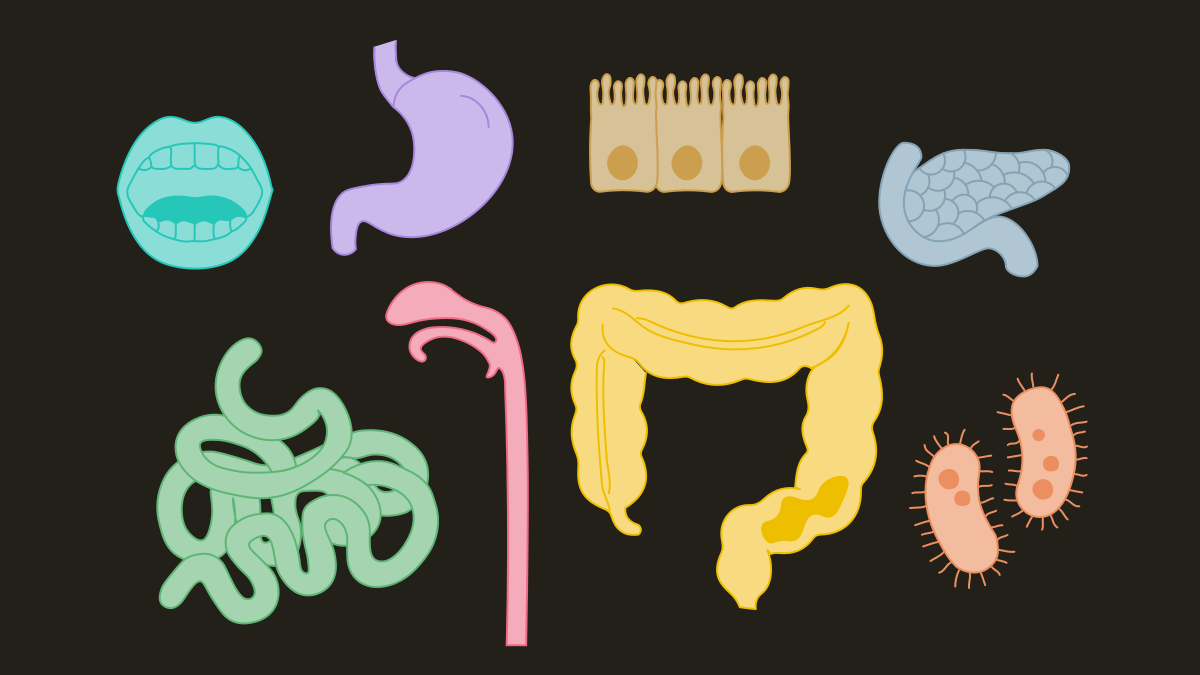
It starts in the mouth. Your tongue is the first machine in the line - it tastes the food, mashes it against your teeth, mixes it with saliva, and shapes it into a swallowable lump. Saliva isn't just water - it contains an enzyme called amylase that starts breaking down starch the moment a piece of bread hits your mouth. The digestion of an apple has already begun before you've finished chewing.
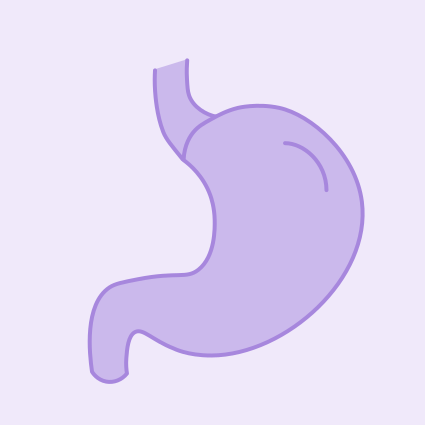
Then you swallow, and the food drops into the esophagus - a muscular tube that contracts in waves to push it downward. This is the same wave motion that lets you swallow upside down, it doesn't need gravity to work. From there the food lands in the stomach, where it spends a few hours in acid strong enough to dissolve metal, breaking down into a thick liquid. The stomach lining renews itself constantly to keep from digesting itself.
Then comes the part that does most of the work - the small intestine, a six-meter-long tube coiled into your abdomen. This is where food gets broken down into pieces small enough to slip through the intestinal wall and into your bloodstream. Almost everything you absorb from food, you absorb here. Water, sugars, proteins, the fats you break down with bile. By the time food leaves the small intestine, most of its nutrients have already crossed into your blood.
After the small intestine comes the large intestine, about a meter and a half of slower, broader tube. Its main job is to pull the water back out of what's left. Trillions of microbes live in there, breaking down what your body couldn't handle alone, and producing some of your vitamins for free. What's left after all of that is the poop your toddler has been asking about. It moves out when there's enough of it to leave.
The whole trip takes roughly a day.
You are a tube
Here's a strange way to picture your body. A long shape with a tube running through the middle, open at both ends. The inside of that tube, technically, is still the outside world. Food in the gut isn't "inside you" yet, not really. The work of being alive is the work of pulling things across the wall of the tube, from outside, in.
When your toddler asks where the food goes, this is the truer answer. It's traveling the length of you. It isn't absorbed in one place, it's pulled through the wall little by little, all along the route.
A second brain
Your gut has its own nervous system, with hundreds of millions of neurons running the entire length of the tract. Scientists are starting to treat it as a brain in its own right.
The technical name is the enteric nervous system. Digestion is just one of its jobs. It talks to your "real" brain all day long, through the vagus nerve and through chemical signals, and the conversation goes both ways. Most of the serotonin in your body, the chemical we usually associate with mood, is made in the gut.
This is part of why gut feelings aren't a metaphor. The signal really is starting in your gut and reaching your brain in seconds. When your child says their tummy hurts, they're feeling something real.
Why I made this pack
It's strange to be a parent and a cell biologist. The questions my daughter asks me about her body are the same ones I was studying back in university, in a form she can't follow yet. The mechanism of peristalsis, the architecture of villi, the role of the vagus nerve. All of them beautiful, and all of them the answer to "where did my poop come from?"
The cards in Pack 6 are the version of that answer she can hold. Eight stations along the route, from the mouth all the way down. She can lay them out in order. She can point to where the apple is right now. She can ask me, every meal, to stick out my tongue, and now we have somewhere to go from there.