How a body begins
I did IVF for my second pregnancy. There's a moment in the process where the embryologist shows you the embryo right before transfer, a tiny hollow ball of cells on a screen.
I trained as a cell biologist. I had watched mouse zygotes divide under the microscope. I knew, more or less, what I was looking at. Seeing it as my own embryo was a completely different thing. Even knowing the science, knowing embryology, knowing how it started and how it would develop if it got the chance... I lay there and could not believe it, that this textbook blastocyst could become a person. I felt like my own science experiment, just with a lot more emotions attached to it.
She is ten months old now. She pulls herself up on everything and puts whatever she finds in her mouth, with a particular obsession for shoes and cables. She has dark eyes, she laughs and giggles a lot even when her older sister is being more rough than gentle. I look at her and still cannot quite believe she came from that ball of cells.
How does one cell become a person?
Before the first cell
You started, like everyone, with two cells.
One was an egg cell, waiting in an ovary. Eggs are some of the largest cells in the body, just big enough to see without a microscope. Eggs carry half the DNA needed to make a person.
The other was a sperm cell. Sperm are some of the smallest cells in the body, tadpole-shaped and built to swim. Sperm carry the other half.
When egg and sperm meet, the two halves merge, and their DNA combines into a single complete set. In my case that happened in a dish in a lab.
The first cell
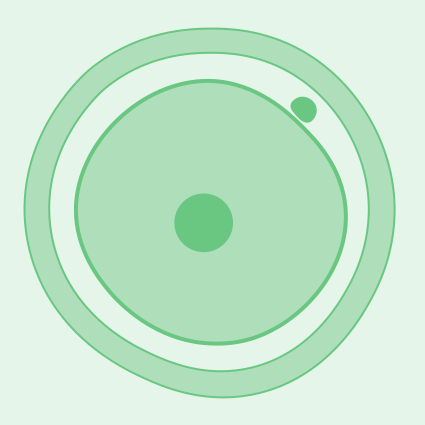
The fertilized egg is called a zygote. It is a single cell, and every other cell in your body descended from it.
This one cell already contains all the instructions to build an entire person - eye color, height, blood type, the shape of a nose, whether hair grows straight or curly - all of it is in that first cell.
Then it divides.
The first divisions
About a day after fertilization, the zygote divides in two. Half a day or so later, those two divide again. The four become eight, the eight become sixteen.
At this stage the cells are still unspecialized, each one doing the same thing as the others. If the group split in two, each half could go on to become a baby, which is exactly what happens with identical twins.
If you take a cell away at this stage, the embryo carries on and the rest make up the difference. It does not matter which one, because none of them is anything in particular yet. That is what makes embryo screening possible at all.
After about four days of dividing, the cells pack into a ball. Embryologists call it a morula, after the Latin for mulberry, because that's what it looks like - a tiny berry of cells.
The first decision
A day or so later, something new happens. The cells start to behave differently from each other for the first time.
The morula hollows out. The cells on the outside will become the placenta and the tissues that support the pregnancy. The small cluster left inside will become the baby. The whole structure is now called a blastocyst.
This is the moment the embryo starts being a body instead of just a ball of cells. The first decision it ever makes.
The blastocyst is usually what gets transferred in IVF. It is what I saw on the screen.
How it becomes a body
After implanting, the embryo grows fast. The inner cells organize themselves into layers, then specialize. By six weeks, there is a curled-up shape with limb buds and a beating heart. By ten weeks, fingers and toes. By nine months, a baby.
In between is one of the most coordinated processes in biology, billions of cells dividing on a schedule, each one ending up in the right place to become the right thing.
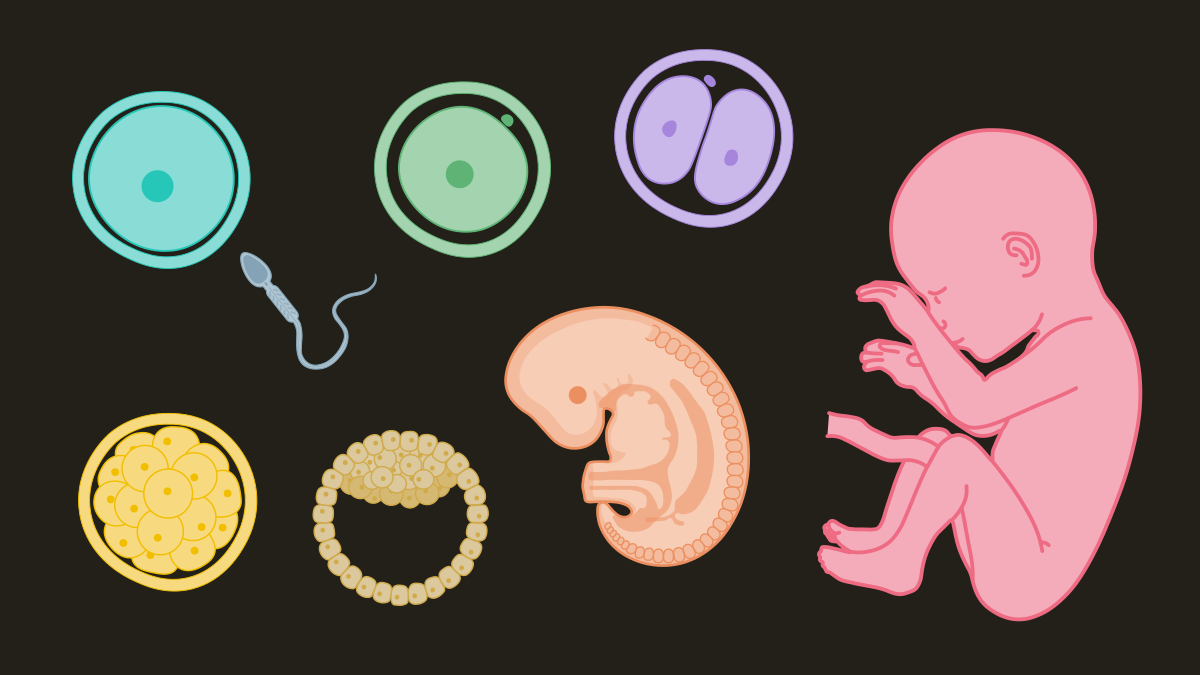
The eight stages in Pack 9 are eight stills: the egg and the sperm, the zygote they make together, the first division, the morula, the blastocyst, the embryo, the baby.
One set of instructions
Every somatic cell in your body has the same DNA. Somatic means the cells that build the body: the heart cell, the brain cell, the skin cell, the cell at the root of a hair. All of them carry the same complete set of instructions, the set that was assembled in the zygote.
The germ cells are the exception. Eggs and sperm carry half a set each.
What makes them different is which parts of those instructions they read. A heart cell reads the parts that build a heart cell, a skin cell the parts that build skin. The rest of the book is still in there, unread.
The zygote contained the instructions to build every kind of cell in your body. As it divided, the cells started to specialize, each one reading a different chapter of the same book.
Still becoming
My daughter is asleep as I write this, on her belly next to her little stuffed monkey. Thinking back to that screen in the clinic, the hollow ball of cells, is just crazy to me.
She is also, technically, older than her big sister. The embryo was frozen before her sister was conceived.
It was already her. Every cell in her came from that one, each reading its own part of the same instructions.